-Tim
 |
| From tpm |
This blog is set up to remember Thomas P MacDonnell who died 21 December 2006. Please post pictures and your thoughts and memories to tim@youngblood.co.uk and I will post them.

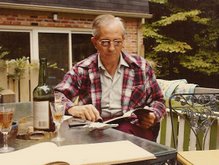
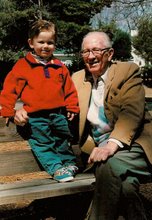
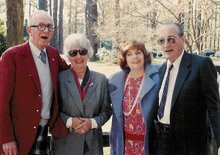

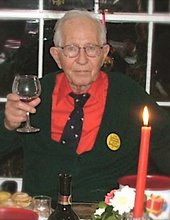
Thomas Paul MacDonnell, 84, died on the 21st of December 2006 surrounded by his family at the Williamsburg Hospice House. He had been a resident of Williamsburg, Virginia since 1980.
Born on Thanksgiving Day 1922 on Staten Island, NY, he was the son of Thomas Snow MacDonnell of New York and Anne Grace MacDonnell originally from Ballinakill, Ireland. During the Great Depression, while his father was an electrical engineer for the Con Edison Company, Thomas attended NYC public schools, served as an altar boy and Boy Scout, before relocating to Larchmont, NY with his Aunt Mary Lorette MacDonnell Broderick and her husband, James G. Broderick, General Counsel and Treasurer of Todd Shipyard in NYC.
In September 1941, after graduation from Manhattan College Prep School, he enlisted in the United States Navy, trained at Great Lakes, Illinois and at Northwestern University and served as a Radioman Second Class, in New Guinea, Australia, the Woodlark, Philippines, New Hebrides, Admiralty and Okinawa Islands and Yokahoma, Japan.
General Douglas MacArthur’s famous “I shall return” promise made to the people of the Philippines people was fulfilled when the invasion took place on October 20, 1944. MacDonnell then a radioman in a US Navy Mobile Communication Unit attached to the Army’s 24th Division was amongst the first to land via Landing Tank Ship on Red Beach, Palo, Leyte, Philippine Islands paving the way for MacArthur’s return. The Unit waded ashore amidst the Japanese machine gun bullets, remarkably suffering only four minor wounds. The sight of MacArthur’s party’s arrival, Thomas later remarked, “I sat down on a rock and watched MacArthur walk ashore.” The LST landings and MacArthur’s return were captured on film and featured in the newspapers. For his service during World War II, Thomas received the Philippine Liberation, Asiatic Pacific, Victory and American Theatre Medals. Later, in Japan he worked at MacArthur’s headquarters during the occupation, and upon discharge from active duty, continued to serve in the US Naval Reserve.
During the war, Thomas’ Aunt Lorette encouraged her young English neighbor, Diana, who had come to Larchmont from Upper Norwood, London with her parents during the Blitzkrieg, to write to her nephew. After successful correspondence, they eventually dated and in 1949, he married his correspondent, Diana Marie Tree, daughter of the late Dulcie Stevens and Roland Tree of London and Larchmont, NY.
After World War II, Thomas studied at The City College of New York, School of Business and worked in sales for Anderson Brick and Supply Company, in Harlem, NY. He had just taken a position with Chubb Insurance Company when called back to active Naval duty in 1950. He served aboard the USS Albuquerque, PF7, patrolling between Yokosuka, Hong Kong and Singapore, later receiving the China and Navy Occupation Service Medals and was honorably discharged from active duty in 1953. In October 1984, he returned to the Philippines with about 500 veterans to celebrate the 40th anniversary liberation of the Islands.
In late 1951, MacDonnell accepted a position at the renowned Henry Stevens, Son and Stiles antiquarian booksellers. It was one of the earliest English firms specializing in Americana, established by Henry Stevens of Vermont in 1843, moved to London in 1845. MacDonnell apprenticed under his father-in-law Roland Tree, who established the NY branch of the firm in the 1940’s, then located at the H.P. Kraus building at 16th East 46th Street. MacDonnell became a partner in 1963. At that time, the London office, located for more then 60 years at 39 Great Russell Street across from the British Museum, relocated to Farnham, Surrey. The NY office moved to Williamsburg, Virginia, in 1980. When the Farnham office closed in 1986, after 141 years in England, the business returned entirely to America.
MacDonnell’s work required extensive travel throughout the United States, Canada, the United Kingdom and other parts of Europe, searching for “nuggets” of history, specializing in manuscripts, books, pamphlets and maps pertaining to the early voyages, travels and exploration of America as well as 18th century colonial history. In the late 1960s, he assisted with cataloguing the books of the Thomas Streeter Collection, which formed the basis for one of the greatest Americana auctions of the 20th Century. In 1988, he hosted a dinner celebrating the History of Printing of the South Symposium held in Colonial Williamsburg.
His vast knowledge of history and meticulous research into historic documents was the basis for scholarship in the numerous antiquarian bookseller catalogues produced by the Henry Stevens firm. Many important documents passed through this firm. He also advised and assisted in the creation and expansion of many private collections, such as the collections of Paul Mellon, Pierre S. du Pont, and Frank T. Siebert as well as many institutions and libraries specializing in Americana, including Yale University and University of Vermont.
MacDonnell was a member of the Antiquarian Booksellers Association, Antiquarian Booksellers Association of America, past President of The Old Book Table, numerous historic associations, and was a life member of the Veterans of Foreign Wars.
He is survived by his wife, Diana Tree MacDonnell, daughter Valerie and husband George Copping, grandchildren Cheryl Klotz, Timothy Klotz, Kevin Copping and Kevin Ernst; son Thomas H. MacDonnell and wife Kaja and grandchildren Kirsten and Christopher, daughter Barbara and husband Thomas O’Donnell and grandchildren Jennifer, Erin, Thomas III, Katie, and great grandchildren Adara and Seraphin. He is also survived by a sister Mrs. Marirose Weymouth, a brother Francis H. J. MacDonnell, and was predeceased by his elder brother, John Joyce MacDonnell.
A memorial service was held at on the 3rd of January, at Bruton Parish Church on the Duke of Gloucester Street in Colonial Williamsburg, Virginia, U.S.A.


No comments:
Post a Comment